
LA port chief on how the Iran war is impacting global trade
Clip: 3/17/2026 | 5m 8sVideo has Closed Captions
LA port chief on how the Iran war is impacting global trade
As the war with Iran continues, businesses and shipping companies are growing increasingly concerned about potential disruptions to the global supply chain. So far, major ports in the U.S. are operating normally, but there are real questions about how long that stability can hold. Geoff Bennett discussed what this could mean for global trade with Gene Seroka of the Port of Los Angeles.
Problems playing video? | Closed Captioning Feedback
Problems playing video? | Closed Captioning Feedback
Major corporate funding for the PBS News Hour is provided by BDO, BNSF, Consumer Cellular, American Cruise Lines, and Raymond James. Funding for the PBS NewsHour Weekend is provided by...
Support provided by:

LA port chief on how the Iran war is impacting global trade
Clip: 3/17/2026 | 5m 8sVideo has Closed Captions
As the war with Iran continues, businesses and shipping companies are growing increasingly concerned about potential disruptions to the global supply chain. So far, major ports in the U.S. are operating normally, but there are real questions about how long that stability can hold. Geoff Bennett discussed what this could mean for global trade with Gene Seroka of the Port of Los Angeles.
Problems playing video? | Closed Captioning Feedback
How to Watch PBS News Hour
PBS News Hour is available to stream on pbs.org and the free PBS App, available on iPhone, Apple TV, Android TV, Android smartphones, Amazon Fire TV, Amazon Fire Tablet, Roku, Samsung Smart TV, and Vizio.
Providing Support for PBS.org
Learn Moreabout PBS online sponsorshipGEOFF BENNETT: As the war with Iran continues, businesses and shipping companies are growing increasingly concerned about potential disruptions to the global supply chain, from rising shipping costs to delayed cargo and vessels stranded at sea.
So far, major ports here in the U.S., including the Port of Los Angeles, are operating normally, with no significant congestion.
Much of that traffic moves along transpacific routes between Asia and the U.S.
but there are real questions about how long that stability can hold as tensions escalate in the Middle East and shipping routes face heightened security risks.
For more on what this could mean for global trade in the weeks ahead, we're joined again by Gene Seroka, executive director of the Port of Los Angeles.
Welcome back to the program.
GENE SEROKA, Executive Director, Port of Los Angeles: Good to see you, Geoff.
GEOFF BENNETT: So there are a number of forces hitting shipping and the global supply chain all at once right now.
Let's start with Iran.
We have heard about the threat, but when might the impact really begin to show up?
GENE SEROKA: Well, it's very interesting, because we're already seeing impacts, but how much and how far they cascade remains to be answered.
For example, we're now about 18 days into this war, and there are about 2,000 ships that normally would have crossed through and back on the Strait of Hormuz.
They're not moving right now.
The price of the ship fuel that we use on the container vessels has more than doubled in the past 2.5 weeks.
And while the transpacific trade accounts for 95 percent of our business and is moving smoothly, it's after lunar new year, where we're typically in a slower time of our season.
GEOFF BENNETT: Well, right.
You pointed out that February volumes were the second highest ever for that month, but this possible seasonal slowdown, what kind of slowdown are you expecting?
GENE SEROKA: Well, realistically speaking, last year, Geoff, we had a pretty big run-up before the tariffs.
And then, as hard policy went in, we saw the ups and downs of cargo flow.
Realistically speaking, we will probably be down about 5 percent this year with the information we have today, just based on the inventory levels across the country from the import side of the business.
GEOFF BENNETT: What about the safety of these vessels going through the Strait of Hormuz?
How much is that reshaping routes, transit times, the cost of moving goods?
GENE SEROKA: It's the focus of our entire industry when it comes to shipping and transportation, and not just containers, the energy products, bulk, agriculture, as well as fertilizers.
Realistically speaking, right now, the Middle East trade for global carriers accounts for about 10 percent of their business, yet all eyes are on this geography and situation.
We have to look at reroutes possibly for fueling of those vessels.
And what do you do with those ships with the Arabian Gulf, as well as the Red Sea, both in high-level security alerts?
Cargo ships are going around the Cape of Good Hope of Africa to get to markets in Europe and the East Coast of the U.S.
GEOFF BENNETT: There's been discussion about military escorts for vessels going through the strait.
How realistic is that?
GENE SEROKA: We're not there yet.
Executives tell me that they are not willing to risk the safety and the lives of their crew, talk about insurance and caravans to go through the strait are nowhere near where we need to be.
And there's not going to be an all-clear sign.
This is going to be progress that has to be worked on, day in and day out.
We haven't seen a real endgame here yet.
GEOFF BENNETT: Given your experience, your past experience working in the Middle East, what other flash points are you worried about when it comes to global shipping?
GENE SEROKA: Well, this goes well beyond what we had seen before, with the attacks on the fueling stations at the Dubai airport, the Fujairah port, which is on the other side of the strait.
And looking upstream in Bahrain and Kuwait, these are all concerning areas, because there's, A, a lot of consumption, and, B, the output from these areas on the energy products is very important to the world markets.
GEOFF BENNETT: In your conversations with administration officials, do you get the sense that they understand the severity here?
GENE SEROKA: Yes, I do, and there are no real clear answers.
This has been a complicated situation for decades.
And one of the concerns we have when I lived in the Middle East was that day that those strait -- that strait closed.
We have reached that, and the consequences are quite dire.
GEOFF BENNETT: What signs are you watching for most closely at the Port of Los Angeles?
GENE SEROKA: Realistically, that cargo flow.
We look at the velocity of the ships, how quickly they're unloaded, the trains and the trucks that move.
And all of those key indicators are really humming at this point, better than where we were before COVID.
Watching that price of fuel, because it will get passed on to the importers and exporters and then ultimately their customers and consumers.
But also if we start to see Asia ports get clogged up because cargo is not moving to the Middle East, that could have secondary impacts in the transpacific markets.And just think of that port congestion that we witnessed several years back.
It's not going to be to that level just yet, but if this becomes a more protracted war in the Middle East, we're going to have to make decisions from there.
GEOFF BENNETT: Gene Seroka, executive director of the Port of Los Angeles, thanks for being here.
GENE SEROKA: Thank you, Geoff.
 New
NewArtists use creativity in protesting immigration crackdown
Video has Closed Captions
Chicago artists channel creativity into protesting the immigration crackdown (7m 27s)
 New
NewA look at Mullin’s rise from MMA fighter to MAGA warrior
Video has Closed Captions
A look at Mullin’s rise from MMA fighter to MAGA warrior and DHS nomination (6m 8s)
 New
NewMideast analysts on Iran’s leadership after Larijani's death
Video has Closed Captions
Mideast analysts on Iran’s leadership after Larijani's death (7m 20s)
 New
NewNews Wrap: Cuba slowly restoring power after blackout
Video has Closed Captions
News Wrap: Cuba slowly restoring power as Rubio calls for new leadership (5m 24s)
 New
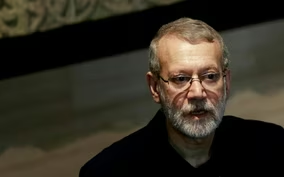
NewStrikes kill Iranian officials in another blow to leadership
Video has Closed Captions
Strikes kill high-level Iranian officials in another blow to country's leadership (4m 48s)
 New
NewVenezuela’s historic run meets USA in WBC final
Video has Closed Captions
Venezuela’s historic run meets USA in World Baseball Classic final (7m 6s)
 New
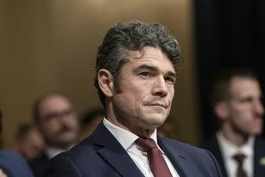
NewWhat Kent’s resignation says about U.S. intelligence
Video has Closed Captions
What Joe Kent’s resignation says about U.S. intelligence and counterterrorism efforts (5m 49s)
 New
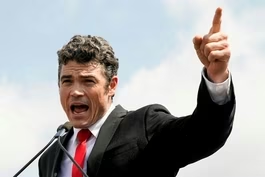
NewWho is Joe Kent, the U.S. official who quit over Iran war?
Video has Closed Captions
Who is Joe Kent, the counterterrorism official who resigned over the Iran war? (2m 15s)
Providing Support for PBS.org
Learn Moreabout PBS online sponsorship
- News and Public Affairs

FRONTLINE is investigative journalism that questions, explains and changes our world.

- News and Public Affairs

Amanpour and Company features conversations with leaders and decision makers.
 From My Station










Support for PBS provided by:
Major corporate funding for the PBS News Hour is provided by BDO, BNSF, Consumer Cellular, American Cruise Lines, and Raymond James. Funding for the PBS NewsHour Weekend is provided by...