Signature Dish
Let's Brunch
Season 4 Episode 1 | 29m 12sVideo has Closed Captions
Neutral Ground in McLean; 1310 Kitchen and Bar in Georgetown; Unconventional Diner in Shaw.
In the season 4 premiere of Signature Dish, host Seth Tillman takes on D.C.'s weekend ritual – brunch! Seth begins at Neutral Ground Bar + Kitchen in McLean, VA for grits and grillades. Next, he revisits a childhood classic, chicken pot pie, at Georgetown’s 1310 Kitchen and Bar, ending with sweet potato shakshuka at Unconventional Diner in Mount Vernon Square.
Problems playing video? | Closed Captioning Feedback
Problems playing video? | Closed Captioning Feedback
Signature Dish is a local public television program presented by WETA
Signature Dish
Let's Brunch
Season 4 Episode 1 | 29m 12sVideo has Closed Captions
In the season 4 premiere of Signature Dish, host Seth Tillman takes on D.C.'s weekend ritual – brunch! Seth begins at Neutral Ground Bar + Kitchen in McLean, VA for grits and grillades. Next, he revisits a childhood classic, chicken pot pie, at Georgetown’s 1310 Kitchen and Bar, ending with sweet potato shakshuka at Unconventional Diner in Mount Vernon Square.
Problems playing video? | Closed Captioning Feedback
How to Watch Signature Dish
Signature Dish is available to stream on pbs.org and the free PBS App, available on iPhone, Apple TV, Android TV, Android smartphones, Amazon Fire TV, Amazon Fire Tablet, Roku, Samsung Smart TV, and Vizio.
Providing Support for PBS.org
Learn Moreabout PBS online sponsorshipANNOUNCER: And now, “Signature Dish,” a WETA original series.
SETH: Today on “Signature Dish,” it's time for brunch.
After traveling back in time to gather the best ingredients.
DAVID: And you can just hear the turning and the clacking and the grinding and it's just, it's like a symphony.
SETH: We'll tackle a timeless treat.
Are we making what I think you're making?
JENN: Chicken pot pie.
SETH: Chicken pot pie.
All right, I'm going right back in for seconds.
JENN: Okay.
SETH: And enjoy an egg-ceptional brunch bite.
LEENA: It's a little bit of a twist.
We are unconventional.
SETH: That is awesome.
I'm Seth Tillman, WETA producer and DC native, and I love good food.
Nice to meet you.
That's why I'm traveling to restaurants across the DMV.
At each stop, looking for the one thing you just gotta try... That Signature Dish.
SETH: We're beginning our journey through the brunch-crazed DMV with a stop in McLean, Virginia.
Right off Old Dominion Drive is Neutral Ground Bar and Kitchen, helmed by chef and native New Orleanian, David Guas.
DAVID: Growing up in New Orleans, I think just being around how important food was culturally was huge for me.
Prior to opening Neutral Ground, I own and operate Bayou Bakery in the heart of Arlington, which we opened to bring New Orleans and southern types of food in a very casual, quick service environment.
We've lived in McLean for 22 years and then we started to sort of get an itch in our own neighborhood.
SETH: In July 2024, Chef Guas opened Neutral Ground and soon after began a special Sunday tradition.
DAVID: Every single Sunday, we have a jazz quartet set up between 10:30 and 2:30.
And it really just is the full circle of being a New Orleanian.
Music, obviously, and food go hand in hand, so it's just the perfect mix of what brunch should be.
Growing up in New Orleans, Neutral Ground is a very specific thing.
It's a median.
It's the piece of land that divides two streets.
So fast-forward now that we're in the nation's capital, it is a rat race, so we wanted it to be a safe haven.
It's a neutral space.
Come belly up to the bar.
Come sit in the dining room.
Enjoy stiff cocktails, unpretentious service, quality food that's made from scratch and forget about all that for a couple hours, you know, it'll be there when you leave.
What I really geek out about is my relationships with people that have their own small businesses where I can bring their product in.
So whether it's our peanuts from Belmont Farms down in Southampton, Virginia, or some of our beef coming from Berryville, we fly our pecans in from Georgia just to make our pralines.
And the beauty of that, you don't have to do much, because it's such an amazing product.
So my relationships of 20 plus years are what really drive me.
SETH: I'm first heading down to Mount Vernon to visit the reconstructed gristmill that once played an important role on George Washington's estate.
It's a spot Chef Guas travels to once a week to source a special ingredient.
Chef.
DAVID: What's up, brother?
SETH: Good to meet you.
DAVID: How are you?
SETH: I am doing great.
Had a beautiful drive on a perfect, perfect day.
DAVID: Perfect day.
SETH: Are we starting here though with a little bit of a history lesson?
DAVID: Much more than a history lesson.
We're here to grab our white corn grits that are going to be part of our signature item for our brunch menu, which is our grits and grillades.
So Cory is actually the master miller.
He's actually waiting for us inside.
So you want to go check him out?
SETH: Let's do it.
DAVID: All right.
Hey, Cory.
How are you, man?
CORY: Morning, Chef.
Good.
How are you, sir?
DAVID: Good to see you.
CORY: Good to see you.
DAVID: This is Seth.
SETH: Cory.
CORY: Hi, Seth.
Nice to meet you.
SETH: Well, I love stepping into this little piece of history.
I love the sound of the water that's rushing in from the creek outside.
How does this whole process work?
CORY: So this hopper's going to feed the millstones below us.
Everything is powered off our 16-foot water wheel.
Water comes in, turns a series of gears below our feet, which makes the top stone turn with the bottom stone stationary that cuts the corn like a pair of stone scissors.
DAVID: The first time I came here to see the mill in full action, it was a spiritual experience.
It was one of those things that everything else, sound-wise, just drops and you can just hear the turning and the clacking and the grinding and it's like a symphony.
SETH: A beautiful symphony powered entirely by water.
I love that.
After Cory adds the remaining white corn to the hopper, it's down a level to start the flow of water and power up the massive machinery.
SETH: And the wheels are turning.
CORY: So we're going to be looking for consistency on the size of the grits.
They're a little small, so we got to make adjustment.
SETH: And this is what's changing the gap between the two stones?
DAVID: And I think Cory knows, because we've tweaked it over the years.
I like a two nickel gap between the stones.
SETH: That's how you measure, in nickels?
DAVID: That's the Neutral Ground spec.
So this is the part I was talking about.
When it's in full operation and you just be quiet for a second, almost even close your eyes, you can feel the vibrations under your feet.
[rhythmic wood clacking] It's wild, man.
It forces you to slow down.
SETH: And amazing that it's just water from a small creek that can create this level of power.
DAVID: I know.
It is.
SETH: As the mill continues to turn, three products are sorted into bins.
The grits, a finer grind called meal, and the leftover hulls, traditionally used for chicken feed.
CORY: Okay, Seth.
We're getting a lot of good grits here.
I'm going to go ahead and shut this off and start bagging them up.
SETH: Sounds good.
And this thing doesn't exactly stop on a dime.
DAVID: No.
I think for me, this relationship is what makes what I do the reason I do it.
It's the fulfillment and the sustainability of these types of partnerships that are so important.
CORY: And Chef Guas, here's your 20 pounds of white grits.
DAVID: Give it to this guy.
SETH: I'm carrying it today?
DAVID: Yeah you are.
That's why I brought you.
SETH: All right, well Cory, thank you so much for this fascinating peek into this little bit of Virginia history right here.
CORY: Absolutely.
And please come back and see us again here at Mount Vernon.
SETH: Oh, we absolutely will.
All right, let's get cooking, Chef.
DAVID: Yeah, man.
SETH: Chef, is this your bike right here?
DAVID: It is indeed.
SETH: You have room in the back there to hold this bag of grits?
DAVID: Not only do I have space for the grits, but guess what, my friend?
You're coming with me.
SETH: Space for me too?
DAVID: You betcha.
SETH: So we're heading up the George Washington Parkway together?
DAVID: We are.
We're going to go back to the restaurant, man.
SETH: Well, thank you for giving me a good, safe helmet here.
DAVID: Safety first always.
Fashion later.
I'm the bug catcher, so I'll be blocking everything that hits me before it hits you.
I'm going to get her upright and then you're just going to go ahead.
SETH: Just go for it.
DAVID: Jump on.
SETH: Here we go.
All right, Chef.
Let's ride.
All right, Chef, that was a fun ride back up here.
Here's your heavy ol' bag of grits.
DAVID: Thank you.
Appreciate it.
SETH: And so everything I know about grits, I think I learned from the movie, My Cousin Vinny.
DAVID: Nice.
SETH: So what does a modern-day chef do to take grits up to the next level?
DAVID: Well, a commonly missed step is to soak the grits and skim the top.
So I'm going to get going on that real quick.
We'll pour cold water over the top and then those outer husks will float to the top.
I'll do that until it's basically clear.
So you see, I just finished these.
SETH: All right.
So now we're getting down to the nitty-gritty.
DAVID: Nice.
SETH: Sorry.
Sorry.
I had to do it.
DAVID: It's all good.
Now, just like gumbo, there's a million different sort of recipes for grits.
Some people put heavy cream, some people put half-and-half, some people put cheese and milk.
For me, the simplest form is just butter and salt.
So we'll get this up to a quick boil.
Now, we've got our washed grits, so we'll add all of that.
So at this point, I don't step away to fold laundry or to go check my Instagram, because the weight of the grits can go to the bottom and then you get it scorched.
SETH: Eyes here.
DAVID: That's right.
I'm actually going to just push this guy to the back a little bit.
And now, we're just going to sort of whisk that every five minutes.
So now it's all about the grillades, right?
The centerpiece is the brisket, so we're getting a brisket instead of a cheapest cut and then we dry rub it with a blend of Creole seasoning that we make in-house with a little bit of coffee and then we'll sear it.
And then from there, we remove the meat and then in that same pan, we'll sauté up some more of our rough vegetables and then a little bit of bay leaf.
Our tomato paste as well.
We'll pour cold water in there.
We'll bring that up to a simmer and then we'll put it in the oven at about 220 and it goes anywhere from 12 to 18 hours.
Here we are 18 hours later, right, and we braised a beautiful brisket.
SETH: Oh, beautiful.
DAVID: So I've actually extracted the braising liquid, so I can focus on our finished sauce.
All right.
So we're going to start off with our onions.
A bit of bell, a little bit of celery and we've got some fresh garlic.
So we'll just sweat this until this is translucent.
So we can't forget about our beautiful grits here.
SETH: Chef, I was so distracted by the garlic, I forgot about the grits.
So I'm glad you're keeping an eye on it.
DAVID: This is my world right here.
And then we've got some fresh heirloom tomatoes.
So we're going to go ahead and keep this simmering.
We got our braising liquid.
A nice Creole brisket stock.
And add a little bit of tomato paste as well.
SETH: Just a little more richness going in the dish.
DAVID: Yeah.
Exactly.
Why not, right?
Can't forget this guy.
We're going to let this come up to a simmer and we're going to reduce it down a little bit.
So once we get this to where we want it, we'll grab our brisket and then take these beautiful, hot grits.
We'll portion that into the bowl and then we'll take this beautiful Creole tomato gravy and put it right over the top of the brisket, finish it with a little chiffonade of green onion.
Call it a day.
SETH: All right, Chef.
The long journey from the gristmill to the plate is complete.
DAVID: We made it.
SETH: This dish looks beautiful.
I got to start with those grits though.
DAVID: Yeah.
Are you kidding me?
SETH: All right, top-notch flavor right there, Chef.
Knowing how much work goes in... DAVID: Sure.
SETH: ...to both creating this product and knowing how little you did to gussy it up and yet still, they are so creamy and fresh tasting.
DAVID: Oh, yeah.
And comforting.
SETH: Very comforting.
But the grillades, that's half the battle right there.
DAVID: Agreed.
SETH: Going for a little brisket here.
DAVID: Do you do the dink it and sink it?
SETH: You tell me, Chef.
DAVID: I already ate mine.
SETH: Dink it and sink it.
Here we go.
DAVID: You're falling behind.
What I love in the sauce is you can pick up the dry rub with the Creole seasoning and the coffee's what gives it the depth.
SETH: Oh, yeah.
But the brisket itself, I guess all of that cooking and it just falls apart when you take a bite.
DAVID: It's unbelievable.
SETH: The dink it and sink it, that's how I'm going to be eating grits for the rest of my life now.
And for you, I know you're trying to go a little more pan-southern here, but it seems like New Orleans will just follow you everywhere you go.
DAVID: Yeah.
This is a little bougie New Orleans, but we invented brunch in New Orleans, so that's why we have signature dishes on Sunday's menu like the eggs sardou, obviously, our fried to order beignets, deviled eggs.
Got to represent the mill as much as possible, so we do our beautiful cornbread.
And we've got our praline bacon, so something a little different.
SETH: Praline bacon.
DAVID: Yeah.
So we take our beautiful pecans from Pearson's Farms in Georgia and we make a sugar sort of mixture with some savory spices and some sweet spices and it's baked into the bacon and there we got our praline bacon.
SETH: Wow.
Feel like I'm down in the French quarter right now.
My goodness.
Can't wait to come back here on a Sunday for some more of this great food.
Two wheels or four wheels, I'm finding a way to get here.
DAVID: Nice.
SETH: Thanks so much, Chef.
DAVID: You bet, don't forget to wear your helmet.
SETH: Safety first.
DAVID: Safety first.
SETH: Next up, we're crossing back into DC with a stop in Georgetown.
Just off Wisconsin Avenue and inside the Georgetown Inn is 1310 Kitchen & Bar, a friendly neighborhood spot run by Chef Jenn Crovato.
JENN: I grew up in Silver Spring, Maryland.
Cooked my whole life in a family of cooks.
I started, actually, a company called Birthdays for Fun in the fifth grade and I'd bring the cake and I'd bring snacks.
And then in middle school, I started doing these frozen pepperoni rolls and then I also delivered pizza by skateboard in our neighborhood.
And then I went to culinary school right out of high school.
I had to do an internship when I was in school.
So I went to I Matti in Adams Morgan, Roberto Donna owned it.
He was like a big brother for many, many years to come.
I told him that one of my dreams was to go to Italy and cook.
And he said, "When you want to go, let me know and I'll help you."
And he did.
Everything was just so fresh and so it taught me a lot about using what you have that's at the peak of its freshness.
And so throughout my years of cooking, people would always ask me, "How did you cook that?"
And they were always really shocked when I told them, I said, "I just use olive oil, sea, salt and pepper."
And they were like, "No.
You must have done something else.
You must have used another spice or another herb."
No.
I just used really fantastic fresh ingredients.
I seasoned it correctly and I cooked it correctly.
SETH: In the early days of the pandemic, Chef Jenn began making homemade chicken pot pies, selling them to go out of the restaurant and local markets.
The pies were an instant hit and have since become a staple on both the regular and brunch menus.
I'm off to 1310 now to give one a try.
Chef, good to meet you.
JENN: Hey.
Nice to meet you.
SETH: Ooh.
We got a roast chicken here and some fresh veggies.
JENN: Yes.
SETH: Are we making what I think you're making?
JENN: Chicken pot pie.
SETH: Chicken pot pie.
All right.
One of my absolute favorite dishes in the world.
How is this all going to come together?
JENN: Actually, our chicken pot pie is a three-day process, start to finish.
It all starts with a roasted chicken.
Olive oil, sea salt and pepper, which is my secret sauce, and we roast them.
350 for about an hour.
We don't do the cubed chicken.
We pull ours apart and I'm just going to add it to some of the veg we already have sautéed.
And the beautiful thing about this is all of the scraps we take and we make a stock with, so there is zero waste.
SETH: And I just love freshly roasted chicken.
It's just the best.
JENN: Me too, and actually, if you want a piece... SETH: Do I want a piece?
JENN: ...with the skin, with the skin is... SETH: Do I want a piece?
JENN: ...actually best.
We take the skin off, but you know.
SETH: Wow.
It's amazing what a little bit of olive oil and salt can do.
JENN: Absolutely.
So we've added our chicken to our veg, put this in here for stock and then we're going to add our velouté to it.
SETH: Velouté?
JENN: Yes.
So to make the velouté, we take equal parts butter, equal parts flour.
That is what's called a roux.
We cook it down for about 10 minutes.
So once the roux is cooked, we add the chicken stock to it and season it with salt and pepper.
SETH: And I can tell, even though there's no cream, that that velouté has added a really, really nice richness and thickness.
JENN: Absolutely.
SETH: Clearly binding it all together.
JENN: It's like gravy on Thanksgiving.
I'm going to season with some salt, pepper.
So now, we're going to fill our containers and I like to leave some of the pieces big and not completely shredded up.
SETH: It's hearty.
JENN: It is hearty.
All right.
So we're going to clear all this off.
I'm going to go grab the crust.
If you could move everything out of the way, I'd appreciate it.
SETH: You're putting me to work?
JENN: Yes.
SETH: All right.
Let's do it.
Yeah.
All right, Chef.
How'd I do?
JENN: This looks good.
SETH: So is this like a puff pastry crust?
JENN: No.
We use typically more of a traditional pie dough.
It's made with flour and very, very important, cold, cold butter and ice water and a little apple cider vinegar.
SETH: You had me at cold butter.
JENN: Okay.
So now I'm going to roll this out.
During the pandemic, all of the chicken pot pies that I did, I rolled by a hand.
We now have a sheeter, which makes life a lot easier, but I wanted to do it the hard way, I guess.
So I just cut around it and we have some little leftovers if you want to do the honors and... SETH: Little chicken.
JENN: ...cut a couple chickens for me.
SETH: These are going to go right on top?
JENN: Yes.
SETH: There you go.
JENN: Perfect.
So if you want to try to crimp one.
SETH: All right.
JENN: And then I'll do the other one.
So it's kind of like... have you ever done an empanada?
SETH: Of course not.
JENN: All right.
So just pinch.
It's just the tiniest little fold.
Start... SETH: I'm not sure baked goods is the next logical step for me.
JENN: It's okay.
Pinch and fold.
SETH: This is just sad.
JENN: It's all right.
It's your first one.
Next, for the egg wash, I just use the egg yolks and a little bit of heavy cream.
I just feel like it makes a more golden crust and I put the chicken on top.
And then we brush the chicken.
Just going to do the same exact thing for this other one.
These are ready for the oven.
SETH: Beautiful.
JENN: So now we're going to put this in the oven at 350 for about 20 minutes.
Once they're golden brown, we'll pull them out and then we'll be ready to sit down and eat.
SETH: All right, Chef.
I see that you were kind enough to give me the professional crust.
JENN: I took yours.
You take mine.
Yes.
SETH: Thank you.
I appreciate it.
I'm guessing this thing is going to be piping hot.
JENN: It's piping hot.
SETH: All right.
So we should do a little venting here?
JENN: Yes.
SETH: Oh, wow.
Here we go.
Love that.
It might be hot, but I'm going in.
JENN: You're brave.
I'm going to let mine cool a little bit.
SETH: Okay.
JENN: I'm going to blow a little.
SETH: That is delish.
JENN: Oh, good.
SETH: There is such a clarity of those flavors.
It's not heavy at all and you really taste those notes of fresh vegetables.
Of course, since I did get a little crust, a nice buttery, rich note to round it all out.
JENN: Well, thanks.
I mean, the focus on making sure every ingredient that goes in there is at its peak and having the chicken stock that's homemade, that totally comes through in this dish.
SETH: I'm going right back in for seconds.
JENN: Okay.
It is lighter than most, right?
SETH: It's light and yet somehow still rich at the same time.
And Chef, I always when I think of brunch, I think of the late, great Anthony Bourdain.
He trashed brunch... JENN: Yes.
SETH: ...As a thing that all chefs hate, but I have to imagine this is fun.
JENN: It is fun.
It's the people who go to church and then have the routine of coming in afterwards.
And being next to Georgetown University, it's a time where all the students come in.
We have a lot of families come in, which I know that was part of the reason that he didn't like it, but it's our favorite meal.
SETH: And people gathering together and enjoying food, that's what it's all about.
JENN: Absolutely.
I typically like to sleep in, so brunch is a time when you can come in and have breakfast food later and you can have huevos rancheros at 2:00 PM.
You can have avocado toast at 1:30.
You can have your kale salad or chicken pot pie any time.
SETH: Well, I'm so glad we were able to feature one of my absolute favorite dishes on "Signature Dish."
I don't think I'm going to be able to go back to any supermarket brands after this, so I think I'll find myself back here for brunch real soon.
Thank you, Chef.
JENN: Thank you.
PATRON: Thank you.
SETH: I'm getting my last fix of brunch in Shaw.
My destination... Unconventional Diner, a spot where brunch is so popular, they offer it seven days a week.
The restaurant, which sits on the outer edge of the Convention Center, was opened by David Deshaies, a French-born chef who cut his teeth with a DC icon.
MICHEL: And fried chicken.
DAVID: Yeah.
I arrived in 2001 in Washington, DC.
I don't speak English.
I come to work directly for Michel Richard, Citronelle restaurant in Georgetown.
SETH: In 2008, WETA's cameras were rolling at Citronelle, capturing David with his mentor, Michel.
DAVID: Even if I was coming from a three Michelin star restaurant in France, Michel say it's simple.
You go back to the base.
So I go back as a line cook and I rise to sous chef after two years and I stay for 15 years with him.
Oh, there's a lot to learn from Michel.
He was always saying that there's no good recipe if you're not able to make it again and again.
On the same time, don't stop with just being okay.
You need to make sure you're looking for greatness.
SETH: David opened Unconventional Diner in 2017.
He now runs it in partnership with Corporate Chef Leena Ali.
LEENA: I think our big thing is comfort food, but it's also comfort food maybe you weren't raised with or comfort food you haven't had before.
The creativity comes from going outside of America to grab international dishes and I think the creativity is what keeps the kitchen fun and going.
DAVID: When we decide to open this restaurant, I was coming from a fine dining world and I don't want to be just doing diner food, meatloaf.
We definitely don't want to be conventional inside the convention center.
A lot of French chefs can be a little bit snobby and say, "Oh, we are a better chef than everybody."
But Michel was actually a chef who really loved America.
Kentucky Fried Chicken was a revelation for him and I tried to do that a little bit here where we embrace American food and even bigger than that, we go across the world.
LEENA: DC is a big brunch city.
Because we do it seven days a week, we actually kind of love it.
Every day, you can come and you can get pancakes.
Every day, you can come and get a chicken and waffle.
DAVID: Brunch was something I learned.
French people doesn't do really brunch, but I think it's a fun operation.
A lot of young people come and brunch together.
It's extremely exciting to see your restaurant full at 9:00, 10:00 AM.
SETH: Chef.
LEENA: Hey.
How are you?
SETH: Great to meet you.
LEENA: Nice to meet you as well.
SETH: Oh, wow.
It smells amazing.
LEENA: Thank you.
SETH: You can hear it with all those onions and it looks like we have a literal cornucopia here today.
LEENA: Of course, yes, we got our sweet potatoes out there, yes.
SETH: What are you making today?
LEENA: We're going to do a sweet potato shakshuka.
This is actually more of a curry and more traditional shakshuka is more tomato-based and we poach our eggs in it, but this one, we actually fry our eggs and we put them on top.
SETH: Got it.
So we're unconventional in every way, shape and form.
LEENA: Exactly.
SETH: And standing here, smells like there's more than just onions in this pot right here.
LEENA: We actually have some garlic and ginger.
I've been sweating this for about an hour.
So now I'm going to start adding the spices.
I'm going to start with paprika.
Then I'm going to add the black pepper and the cumin.
Then I'll add the turmeric, the salt, some red pepper flakes.
I have some ground ginger going in this.
SETH: Lots of ginger.
LEENA: And then I'm going to finish with some curry powder.
The spices are actually going to get a nice fond on the bottom, so when I deglaze it, it's actually going to add to the flavor.
Then I'm going to start adding the rest of the liquid ingredients.
SETH: All right.
What are we starting with, Chef?
LEENA: I'm going to start with actually our house made pomodoro sauce first.
We cook this for about five to six hours.
SETH: So there will be some tomatoes going into this shakshuka?
LEENA: There is tomatoes.
SETH: All right.
And is this a veggie shakshuka?
LEENA: No.
This is completely vegan, actually.
SETH: There are some people that'll be very happy to hear that, I think.
LEENA: Yes.
I'm going to add the coconut milk now.
SETH: Ooh, the color is beautiful.
LEENA: Now, I'm just going to let it simmer and cook down a little bit to get the right consistency.
SETH: And what was your inspiration for going a little unconventional with this shakshuka?
LEENA: I wanted, not a bolder flavor, but I wanted it a little bit different.
Shakshuka's already Middle Eastern and I'm Middle Eastern, but I wanted a little bit of a play on it, especially with the sweet potatoes.
I mean, I love sweet potatoes.
I haven't met anybody that doesn't love sweet potatoes.
SETH: All right.
I'm sure there's someone out there.
Hopefully, they're not watching.
LEENA: We're going to start adding the remaining ingredients.
First, we have our sweet potatoes.
SETH: The star of today's show?
LEENA: Yes.
SETH: And it looks like these have already been seasoned up.
LEENA: Yes.
So we dice these and we toss them with some olive oil, salt, pepper and we roast them for about 30 to 45 minutes.
All right.
And then if you don't mind, can you pass me the chickpeas, Seth?
SETH: I sure can.
LEENA: Actually, we started with our shakshuka with just a chickpea curry.
It was actually later we added the sweet potatoes.
So now to add actually just a splash of Tabasco, I think it rounds it out nicely.
It's a little bit acidic.
SETH: And that's not too much, so we're not talking about a spicy shakshuka here.
LEENA: No.
No.
It's not too spicy.
SETH: Okay.
Just a little, tiny note.
LEENA: A little kick.
I'm going to cut off the heat and I'm going to add the lime juice.
Now, I'll finish it just with some herbs.
I have some cilantro, some parsley.
SETH: The cornucopia promised a beautiful pot of fresh veggies and you've delivered, Chef.
LEENA: Thank you so much.
Now that the sweet potato curry is finished cooking, we're going to turn to plating the dish.
So to fry our eggs, I use clarified butter that reduces those little black bits you get around your eggs.
We're going to do our egg sunny side up, so the wipes are nice and set, but you have a runny yolk.
We're going to ladle our shakshuka into the dish.
Then we'll add on top the egg and then we will finish with a garnish of affilla cress and watermelon radish.
Then it will be ready to enjoy.
SETH: All right, chefs.
This shakshuka dish looks beautiful, but it looks like we have some classic brunch cocktails to go along with it.
What are we drinking, Chef?
DAVID: So I have the Bloody Mary.
Leena, she get her favorite drink, the matcha latte and you get the espresso martini.
SETH: Oh, that's the new hotness these days.
The espresso martini.
Well, cheers.
DAVID: Cheers, guys.
LEENA: Cheers.
SETH: That's delicious.
And with the espresso, help wake you up a little bit too.
(laughter) But I'm just going to dig right in.
Spoon for this?
LEENA: Yes.
SETH: All right.
What's the spice on top, Chef?
LEENA: Togarashi.
It's actually a Japanese spice.
It's a red pepper with some black sesame seeds in it.
SETH: Mmm.
All right.
That is awesome.
I love how kind of curry forward it is.
The spices like the cumin and the turmeric give it a real depth of flavor, but you know you still have that runny egg yolk and the freshness with those garnishes on top really kind of give it a pop.
DAVID: And you don't feel guilty, because it's vegetarian.
SETH: Of course, but it's certainly not lacking for heartiness.
Oh, and some naan to go along with it.
DAVID: Oh, yeah, you have to go with the naan bread, yeah, with za'atar.
We love it.
I serve you, Leena?
LEENA: Yes, please.
DAVID: Yeah.
SETH: That naan is so nice and buttery.
And the za'atar on top really kind of rounds out all these Middle Eastern flavors, but it looks like we also have some classics.
I see some chicken and waffles and a salad.
And tell me about this dish right here, Chef.
DAVID: Oh.
This is crème brûlée French toast.
It's a brioche dough that has been stuffed with a crème brûlée and we just soak it in vanilla, touch of cinnamon and we toast it and caramelize with brown sugar.
We serve it with a raspberry coulis.
SETH: Wonderful.
And you know when I come to brunch, I want something a little sweet.
I want something a little savory.
And you know, I always hear all the time, brunch is king here in DC.
But I'm always kinda curious, there's a lot of other big cities in this country, why is DC such a brunch capital?
DAVID: You know what?
I've been here for 25 years and I still don't know.
It's true.
Washington DC is very popular for their brunch and I don't explain it.
LEENA: I think brunch is popular, because there's a lot of young professionals in DC and you can really stretch a dollar.
It's a really great value.
I mean, you have a lot of options and a lot of great dishes to choose from.
SETH: And David, obviously, you know, you saw a market here, because you're not just doing it on Saturdays and Sundays, but you're doing it all week long.
DAVID: Everyday brunch.
And for example, the shakshuka is such a popular demand that we also serve it for dinner, all day until 10:00 PM.
SETH: Well, that's a testament to just how good this shakshuka is.
You really knocked it out of the park and I cannot wait to come back here for brunch any day of the week.
Thank you both so much.
LEENA: Thank you.
DAVID: Thank you.
♪ ♪ ♪ ♪ ANNOUNCER: To find out more about great food in the Washington metro area, visit weta.org/signaturedish.
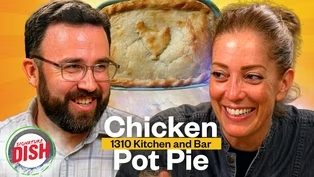
1310 KITCHEN AND BAR's Chicken Pot Pie Takes Three Days to Make!
Video has Closed Captions
Clip: S4 Ep1 | 4m 32s | Seth heads to 1310 Kitchen and Bar to learn the secrets behind Chef Jenn Crovato's chicken pot pie. (4m 32s)
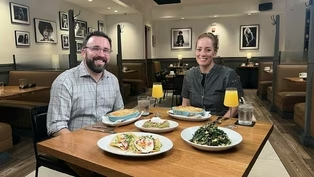
Preview: S4 Ep1 | 30s | Neutral Ground in McLean; 1310 Kitchen and Bar in Georgetown; Unconventional Diner in Shaw. (30s)
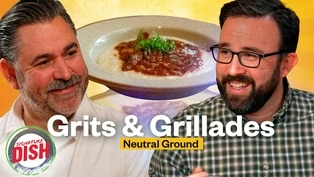
The Secret to NEUTRAL GROUND's Grits and Grillades Starts at the Mill
Video has Closed Captions
Clip: S4 Ep1 | 7m 45s | Seth samples Neutral Ground's seasoned grits topped with slow-braised brisket grillades. (7m 45s)
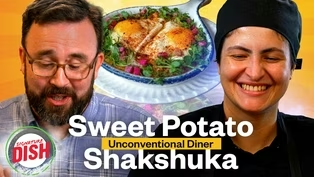
Watch the UNCONVENTIONAL DINER Make Shakshuka with a Twist: Za'atar and Sweet Potato
Video has Closed Captions
Clip: S4 Ep1 | 4m 14s | Seth heads to the Unconventional Diner where Chef Leena puts an unconventional spin on shakshuka. (4m 14s)
Providing Support for PBS.org
Learn Moreabout PBS online sponsorship
- Food
Christopher Kimball’s Milk Street Television
Transform home cooking with the editors of Christopher Kimball’s Milk Street Magazine.




Support for PBS provided by:
Signature Dish is a local public television program presented by WETA